
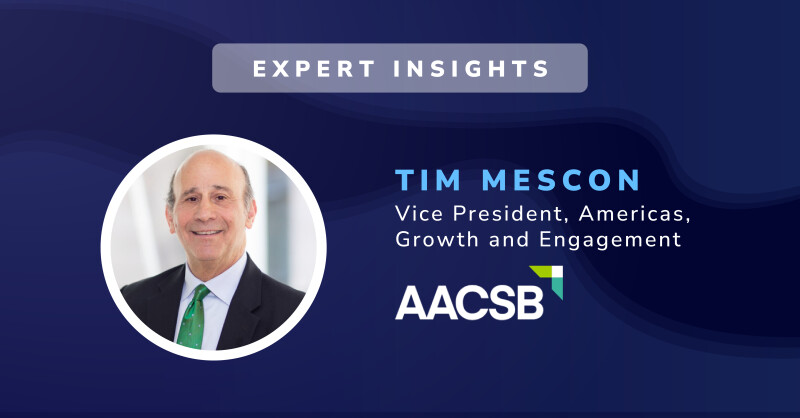
I've spent many years teaching, leading, and visiting at business schools, and I can tell you: the competencies and conversations happening in dean's suites right now are different. They're more urgent. The enrollment pressures are real, the competitive dynamics have shifted, and a new challenge is emerging that many institutions haven't fully reckoned with yet.
Earlier this year, I had the opportunity to join Everspring and Cal State Fullerton's College of Business and Economics for an executive briefing on AI, enrollment, and what Everspring's team aptly called the "new visibility gap." It was one of the more energizing conversations I've had in recent memory—not because the news was all good, but because the right people were in the room asking the right questions.
Here are three things every business school leader should be thinking about right now.
1. The enrollment picture is more uneven than the headline numbers suggest.
AACSB's most recent Enrollment Trends at AACSB Business Schools: 2025 report shows demand for business education is genuinely rising. Undergraduate applications are up 38% over the past five years, and master's applications have climbed 25%. That's a story of resilience.
But as I shared at the briefing, that growth is deeply uneven. International enrollment recovery remains uncertain. Visa interview backlogs have created real disruptions. Some institutions in the U.S. are facing close to 20% headcount reductions because of international student enrollment drops. Meanwhile, the competition for domestic students is intensifying, and specialized master's programs have now overtaken MBA enrollment across much of the U.S. and the world.
The schools that are thriving are doing so by being agile. They’re recalibrating their program mix, reaching non-traditional students, and doubling down on career outcomes and competencies as a primary differentiator. The ones that are struggling tend to be waiting for the market to return to the way it was. The market isn't going back.
2. AI has fundamentally changed how students discover programs, and most institutions are invisible in that process.
This is where my colleagues at Everspring brought data that captured the attention of all in the room. The search journey for graduate programs has changed dramatically. Tools like ChatGPT, Perplexity, and Google’s AI Overviews are increasingly becoming the first place prospective students go for answers, and 80% of searches now end without a click on any result. In other words, prospective students’ first engagement is often with AI, not with your institution. And if your school is not showing up in that answer, you may not make the consideration set at all.
The conversion data makes this even more compelling. Everspring's research shows that leads arriving from organic search or AI platforms convert to applicants at significantly higher rates than paid channels. Losing 100 organic inquiries requires more than 200 paid search inquiries to generate the same number of applications. At the same time, cost-per-click has surged more than 45% year-over-year. The math is brutal for institutions still operating on yesterday's marketing playbook, and technology is moving at lightning speed.
Perhaps most striking: universities show up in AI Overview answers less than 4% of the time. For a prospective student using ChatGPT to ask "what's the best online MBA in California if I want a job in Silicon Valley?"—a perfectly normal query today—a consideration set of six schools is generated, and most programs simply don't appear.
3. The institutions winning right now are doing a few specific things differently.
What emerged from our conversation at Cal State Fullerton, drawing on what AACSB is seeing across member schools and what Everspring has tracked through their research, is that the gap between struggling and thriving institutions often comes down to a handful of high-impact decisions, not sweeping transformation. The schools pulling ahead have accepted that student discovery has fundamentally changed and reorganized accordingly:
- They're staying close to how prospective students are actually searching—outcomes-based, AI-mediated, and rarely brand-driven.
- They're building content that answers the questions students are asking before they ever reach a program page.
- They're making sure their institutions show up where AI platforms are looking, not just where Google used to look.
- And they're rethinking how and where they deploy their marketing dollars, because the channels that drove results two years ago are delivering a fraction of what they once did.
None of that is simple to execute. But the schools I'm most optimistic about aren't necessarily the best-resourced. They're the ones asking the right questions early and acting strategically on the answers.
A Final Thought
The data is available. The strategies are emerging. And the urgency is real. I've sat with enough deans and provosts in the last year to know that the institutions treating this as a future problem are already behind. The ones leaning in and asking hard questions, testing new approaches, and staying close to how student behavior is actually changing are the ones I'm most optimistic about.
That's ultimately what energizes me about convenings like this one. The answers are in the room. We just have to keep showing up to find them.