
Business schools are under pressure from every direction. Employers expect AI fluency. Students expect more from their degree. And the tools change faster than any curriculum cycle.
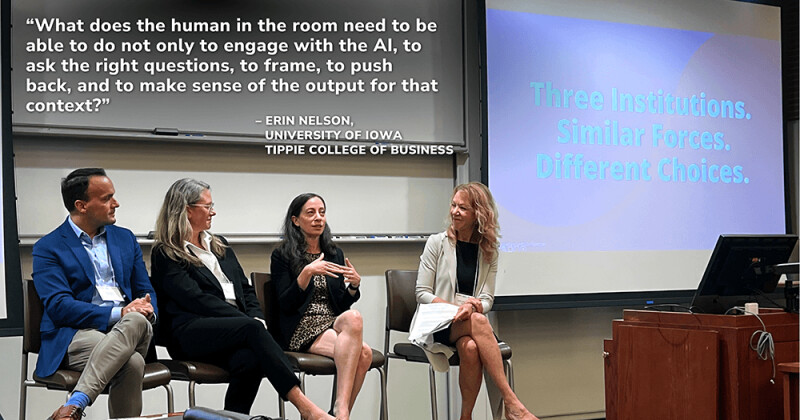
We recently hosted an Executive Briefing with the Graduate Business Curriculum Roundtable at Chicago Booth’s Gleacher Center, where leaders from the University of Chicago Booth School of Business, DePaul University’s Driehaus College of Business, the University of Iowa’s Tippie College of Business, the University of Notre Dame’s Mendoza College of Business, and Indiana University’s Kelley School of Business shared the strategic bets they’re making based on their students, their strengths, and where they see opportunity ahead.
Here are 10 key takeaways.
1. Should business schools create an AI MBA?
Most leading business schools are building AI throughout their existing MBA instead of launching a separate AI degree. As one Booth faculty member put it, e-commerce didn't need its own specialization. It became the way business is done.
DePaul integrated AI into every core MBA class and added a specialization in AI management strategy. Tippie created stackable AI certificates that MBA, finance, and business analytics students can combine to fit their goals.
Once AI is part of every program, what sets a school apart is everything it's already known for.
2. What skills do employers want from business graduates in the AI era?
Strong business skills, with AI built in. In Everspring's analysis of 1.14 million job postings for master's-level business roles, communication and leadership led the general skills, and finance, accounting, and marketing were among the most requested business skills. AI showed up most often alongside analytics, as a force multiplier for the work employers already need done.
Schools are building both. In a marketing research class at DePaul, students use AI to write code each week, then defend their analysis of a real company's case the way they would in front of a CMO. Tippie doubled down on communication and collaboration, the skills that matter most once AI writes the first draft.
3. How should business schools read employer signals about AI?
Start with your own recruiters. Employer signals vary by school and industry.
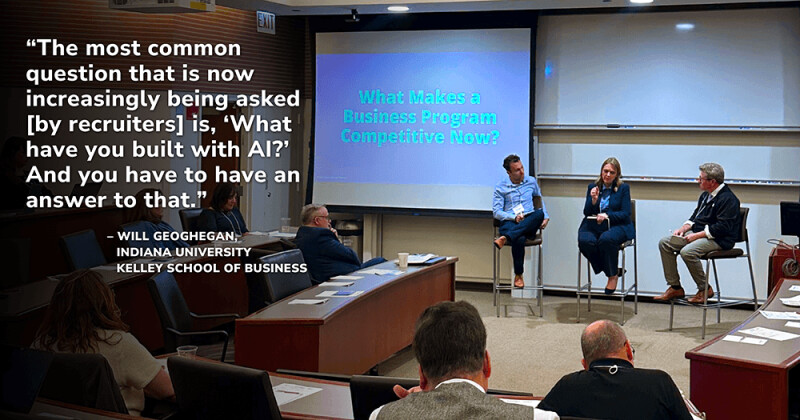
Notre Dame's recruiters prioritize teamwork, collaboration, and leadership, so Mendoza is building on its reputation for ethical leadership with a focus on responsible AI. Kelley's recruiters increasingly ask candidates what they've built with AI, so Kelley's undergraduate program now requires 12 AI credits in the first two years.
And read national headlines closely. Scott Jeffe, Everspring's Vice President of Market Research and New Markets, noted that many hiring surveys sample CEOs. Hiring directors, the people who actually sort résumés, still rely on the degree.
4. How are students using AI before they reach the classroom?
Students arrive already using AI and eager to learn more. Faculty are finding that some students even have AI agents answering their email. At DePaul, "Where will I learn about AI?" became the most common question at MBA orientation.
Many students feel their programs haven't caught up yet. In research Everspring shared, only 27% of students said their academic program had meaningfully integrated AI. Schools are responding by building AI into coursework and giving every student access to leading AI tools.
5. How are business schools getting faculty on board with AI?
AI adoption depends on three things: faculty engagement, shared frameworks, and opportunities to experiment.
- Engagement spreads through peers. At Booth, adoption is bottom-up. When a few faculty members shared how they use AI in their classes, 30 to 40 colleagues came to learn from them.
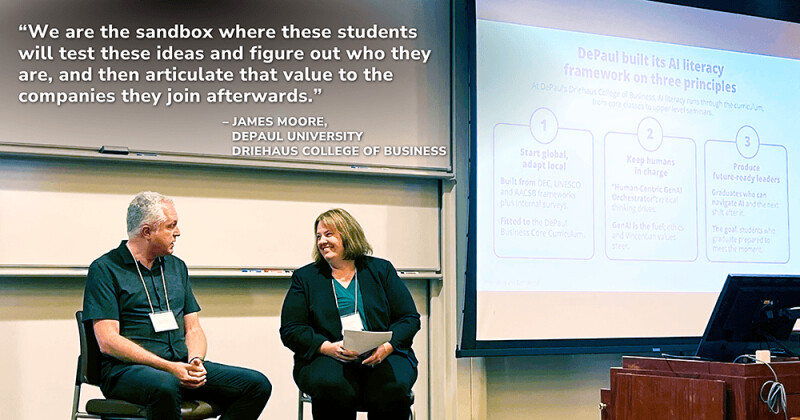
- Shared frameworks give faculty a common starting point, and an in-house expert helps them put it to work. At DePaul, James Moore, Director of Online Learning at the Driehaus College of Business, plays that role, giving faculty a trusted place to turn as they experiment. For more, read his post, Five Ways to Build Buy-In for AI in Higher Education.
- Experimentation needs dedicated time. Kelley drew more than 200 faculty to full-day summer workshops, allowing faculty to work through their own courses and rethink assignments with AI in mind.
6. How are business schools setting expectations for AI use?
Schools are setting clear guidelines at the assignment level. When students know the rules, they experiment with more confidence.
Some schools use a simple color-coded system on every assignment, so students know when AI is encouraged, allowed with guardrails, or off limits. Others publish a full faculty and student playbook and show each course's level of AI use before students enroll. Schools are also mapping their curriculum to an AI framework, creating a clear throughline across programs.
7. How should assessment change when students use AI?
Assessment is being rebuilt to show what students know on their own and how well they use AI to do better work. That pushes every department to define what its graduates need to be able to do before AI enters the picture.
Kelley separates "bedrock" assessments, taken without a computer, from "signature" assessments that bring AI into the work. It also built a free tool, Kelley Course Coach, to help faculty sort their assignments. Other faculty are building AI directly into assignments so they can see how students work through a problem and coach them along the way.
8. How can business school curriculum keep pace with AI?
Build programs that can change every term while the fundamentals stay put. Some faculty now update course material almost weekly as new models are released. Tippie builds courses in modules, so concepts like weighted average cost of capital stay in place while applied material changes with the tools. Schools are also leaning on structures that can move quickly, like special-topics courses that can be refocused each year, dedicated class time for what's new in a field, and new minors and concentrations.
9. What do students value most in a business school education today?
The people. As information gets easier to find, community becomes a bigger part of what students pay for. When students were asked why they’d pay to learn something they could find on YouTube, they pointed to each other.
Schools are investing in those connections. DePaul made its full-time MBA fully in person, and students felt the difference within a year. Tippie designs in-person experiences for its online students, including the option to take a course at its campus in Italy.
10. How do prospective students find business programs in AI search?
They ask AI. Prospective students now research programs in ChatGPT, Gemini, and Claude, asking about outcomes, cost, and careers before they ever contact a school. Andrea Gilbert, Everspring's Executive Vice President of Solutions Marketing, pointed to Everspring research showing that branded searches, or searches that start with a university name, are down 22% on average.
Students are starting with questions about careers, specializations, cost, and flexibility, and AI answers those questions with a shortlist of schools. The schools that show up are the ones that clearly connect their programs to what students are asking, regardless of size or ranking.
When Everspring helped DePaul’s MS in Accountancy show up in AI-generated answers to the questions career changers were asking, enrollment grew 282%.
Want to know how your programs show up? Get a complimentary AI visibility scan.
Keep the Conversation Going
Everspring gives business schools an advantage they can measure in enrolled students. Our AI search strategy for the University of Kansas School of Business drove an 8X increase in AI visibility and a 291% increase in AI-driven applications. For a California business school, we lowered cost per enrollment 6% even as cost per lead rose 47%. Whatever bets your school is making next, we make sure the right students find them.
Weighing a program, portfolio, or curriculum decision? We’d welcome the chance to hear what you’re working on and share more from our conversations with business school leaders.
